
A roof leak is frustrating enough the first time. But when you’ve already paid for a repair and water starts coming through your ceiling again after the next heavy rain, it becomes a much bigger problem.
If your roof leak keeps coming back after repair, the issue may not be as simple as a small hole or damaged section of roofing. Water can travel underneath roofing materials, enter through flashing or roof penetrations, collect around drains, or come from a completely different part of the roof than where the interior stain appears.
This is especially important in Brooklyn, where many brownstones, rowhouses, townhouses, apartment buildings, and commercial properties have flat or low-slope roofing systems where drainage, flashing, seams, parapets, and roof penetrations can all affect water intrusion.
At Bobby Contracts Inc., we have 20+ years of experience working on Brooklyn roofs, including roof repairs, flat roofing, leak detection, flashing repair, roof replacement, and drainage problems. Our approach is to identify the source of the water before recommending the appropriate repair.
Bobby Contracts Roofing Contractors in Brooklyn, NY
Why Does My Roof Leak Again After It Was Repaired?
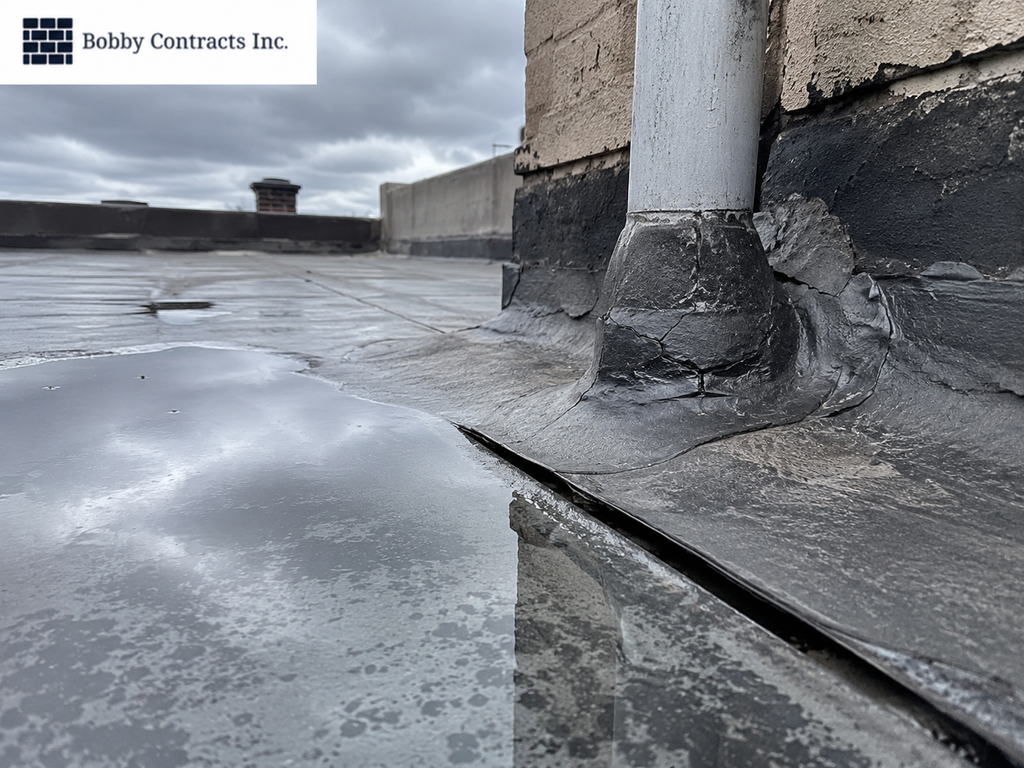
A recurring roof leak usually means one of three things:
- The original problem was not correctly identified.
- The repair addressed the symptom but not the source.
- There are multiple points of water entry or a larger underlying roofing problem.
A repair can appear successful when the weather is dry, only for the leak to return during a strong storm.
This exact frustration comes up repeatedly in Brooklyn and NYC homeowner discussions.
For example, a Brooklyn townhouse owner described having the same leak return after the original roofer came back several times to reinforce the roof. The homeowner eventually asked whether there was a professional who could actually investigate the source rather than repeatedly patching the same area.
A Park Slope homeowner described a similar situation: repairs had already been attempted, but water continued entering during heavy rain and wind. They were specifically looking for someone who could identify the root cause instead of simply performing another repair.
These situations illustrate an important point:
A recurring roof leak requires diagnosis, not just another patch.
What Could Be Causing a Roof Leak That Keeps Coming Back?
1. The original leak source was never identified
The location of a ceiling stain is not necessarily the location where water entered the roof.
Water can move along:
- Roof decking
- Rafters
- Joists
- Insulation
- Roofing membranes
- Masonry
- Flashing
- Other building components
This means a water stain in a bedroom or hallway could originate several feet—or even farther—from the actual point of entry.
That is why simply sealing the area directly above the stain may not permanently solve the problem.
A proper roof inspection should look at the surrounding roofing system and potential water-entry points rather than assuming the visible stain identifies the source.
2. Damaged or failed flashing
Flashing is installed around areas where roofing materials meet other structures, including:
- Chimneys
- Skylights
- Vents
- Pipes
- Roof edges
- Walls
- Parapets
- Other roof penetrations
When flashing cracks, separates, corrodes, or loses its seal, water can enter during rain.
3. Cracks or failed seams in a flat roof membrane
Flat roofs are particularly vulnerable to problems involving seams and membrane deterioration.
Depending on the roofing system, a roof may use materials such as:
- TPO
- EPDM
- Modified bitumen
- Other membrane systems
If seams separate or the membrane develops cracks, bubbles, punctures, or deteriorated areas, water can enter underneath the surface.
A Brooklyn homeowner recently asked Reddit about a 20–25-year-old flat roof where leaks appeared around roof penetrations and pipes, while the roofer also found cracks in the membrane. The homeowner was trying to determine whether repairs would be sufficient or whether the roof needed replacement.
That is an important distinction: a leak doesn’t automatically mean you need an entirely new roof—but repeated leaks can be a sign that the existing system has reached the point where patching is no longer the best long-term solution.
4. Ponding water and poor drainage
Water should move toward the roof’s drainage points.
If water remains standing on a flat roof after rainfall, it can place additional stress on the roofing system and increase the risk of deterioration.
Drainage problems can involve:
- Clogged drains
- Improper roof slope
- Blocked drainage paths
- Low spots
- Damaged gutters
- Poorly positioned downspouts
- Deteriorated drainage components
5. The roof has multiple problem areas
Sometimes the first leak is not the only leak.
An older roof may have several deteriorated areas, including:
- Aging membrane sections
- Failed flashing
- Cracked sealants
- Damaged roof penetrations
- Low areas where water collects
- Deteriorated edges
- Old repairs
In this situation, repairing one area may temporarily stop one leak while another develops later.
That is one reason why a roof that has required repeated repairs should be evaluated as a complete system rather than treated as a collection of isolated holes.
6. The roof is simply reaching the end of its useful life
Repeated leaks can sometimes indicate that the roof has become too deteriorated for individual repairs to provide a reliable long-term solution.
Age matters.
The type of roofing system, installation quality, weather exposure, maintenance history, previous repairs, drainage and overall condition all affect how long a roof lasts.
The question should not simply be:
“Can this leak be patched?”
It should be:
“Will repairing this area provide a reasonable long-term solution, or is the roofing system deteriorated enough that replacement makes more sense?”
“My Roofer Has Already Fixed It Several Times. Why Is It Still Leaking?”
This is one of the most important questions homeowners should ask.
If a contractor has already attempted multiple repairs and the same leak continues, doing the exact same type of repair again may not solve the underlying problem.
A Brooklyn townhouse homeowner on Reddit described having the roofer return approximately five times while the leak continued during heavy rain. The homeowner specifically wanted someone who could investigate the leak rather than repeatedly reinforce the roof.
The lesson is simple:
If the same repair keeps failing, the diagnosis needs to be reconsidered.
The next inspection may need to examine a wider area of the roof and consider flashing, drainage, penetrations, membrane condition, adjacent masonry and other potential entry points.
“Why Does My Roof Only Leak During Heavy Rain?”
This is another common question.
A roof can remain apparently dry during light rain but leak during a major storm.
Heavy rain can introduce:
- More water volume
- Stronger wind-driven rain
- Greater pressure around roof transitions
- More water entering drainage systems
- Overflow from clogged or undersized drains
- Water reaching areas that remain dry during lighter rainfall
A Park Slope homeowner described water entering only when rain and wind were heavy enough, even after previous repair attempts.
So if your roof only leaks during severe weather, that does not necessarily mean the roof is fine the rest of the time.
It can mean the defect only becomes apparent when the roofing system is exposed to a larger volume of water or wind-driven rain.
“Do I Need a New Roof or Just Another Repair?”
This is probably the most important financial question homeowners have.
The answer depends on the condition of the existing roof.
Roof repair in brooklyn may make sense when:
- The damaged area is isolated.
- The roofing system is otherwise in good condition.
- Flashing has failed but the surrounding roof remains sound.
- A limited membrane defect can be properly repaired.
- Drainage issues can be corrected.
- The roof has sufficient remaining service life.
Roof Replacement in brooklyn may make more sense when:
- The roof is significantly aged.
- Leaks are occurring in multiple locations.
- The membrane is broadly deteriorated.
- Previous repairs keep failing.
- There are widespread cracks or defects.
- Drainage problems have caused extensive deterioration.
- The cost of continued repairs approaches the value of a replacement.
A recent Brooklyn flat-roof discussion illustrates why this decision can be difficult: the homeowner received different options for repairing an aging roof versus replacing it and was unsure whether the less expensive repair would provide a reliable long-term solution.
There is no universal answer based only on the age of the roof or the size of one leak. An on-site inspection is necessary.
“Why Are My Roofing Quotes So Different?”
This is another question that frequently appears in homeowner discussions.
One Brooklyn homeowner shared four different quotes after experiencing recurring leaks and was surprised by how dramatically the proposals differed. The roof was a roughly 1,000-square-foot flat metal roof, and the proposals included very different scopes of work.
This is why homeowners should not compare roofing estimates based solely on the final dollar amount.
Compare:
- Exact scope of work
- Roofing system being proposed
- Materials
- Flashing work
- Drainage work
- Areas being repaired
- Whether damaged material is removed
- Warranty terms
- Cleanup
- Labor
- Whether the estimate addresses the suspected source of the leak
A $5,000 quote and a $10,000 quote may not actually be proposing the same work.
What Should You Do If Your Roof Keeps Leaking?
If the leak has already been repaired once and returned, consider these steps:
1. Document when the leak occurs
Note:
- How heavy the rain was
- Where water appeared
- Whether wind was involved
- How long after the rain the leak appeared
- Whether the leak appears in the same location
- Whether there are multiple affected areas
This information can help the contractor understand the pattern.
2. Don’t assume the ceiling stain is directly below the leak
The visible interior damage may be downstream from the actual entry point.
3. Have the roof inspected beyond the immediate area
The inspection should consider the roofing membrane, seams, flashing, penetrations, drainage and adjacent structures.
4. Ask what the contractor believes is causing the leak
Don’t be afraid to ask:
“What is the actual source of the water?”
and:
“What evidence did you find that supports this repair?”
5. Ask whether the problem is isolated or widespread
If the roof has multiple defects, repeatedly repairing individual areas may not be the most cost-effective strategy.
6. Get a written scope of work
A written estimate should make it clear what the contractor intends to repair or replace.
Bobby Contracts’ Brooklyn roofing process includes an on-site inspection followed by an itemized written estimate outlining the scope, materials and recommended solution.
How Bobby Contracts Approaches Recurring Roof Leaks in Brooklyn
Roof Leak or Basement Water Problem?
Get a free on-site inspection and written estimate from Brooklyn’s trusted roofing & waterproofing experts.
Chat on WhatsApp for a Free InspectionBobby Contracts Inc. has 20+ years of experience providing roofing services in Brooklyn.
The company works with:
- Brownstones
- Rowhouses
- Townhouses
- Multi-family buildings
- Apartment buildings
- Commercial properties
- Residential homes
Its roofing services include roof repair, roof replacement, flat roofing, leak detection, flashing repair, drainage-related work and preventative maintenance.
One important part of the approach is determining where water is actually entering the building.
Water can travel from flashing, seams, drains, roof penetrations and other areas before becoming visible inside the property. Bobby Contracts specifically describes its leak-detection approach as tracing water back toward the actual source rather than simply repairing the location where the damage becomes visible.
The company also states that the crew inspecting the roof is the same crew performing the work, rather than relying on subcontractors, and that projects begin with written scopes and estimates.
If you’re dealing with a recurring roof leak in Brooklyn, you can learn more about Bobby Contracts’ roofing services here:
Roofing Contractors in Brooklyn, NY — Bobby Contracts Inc.
Frequently Asked Questions About Recurring Roof Leaks
Why does my roof keep leaking after being repaired?
The original source may not have been correctly identified, the repair may not have addressed the underlying problem, or the roof may have multiple damaged areas. Flashing, seams, roof penetrations and drainage problems can all cause recurring leaks.
Can a roof leak come from somewhere other than directly above the ceiling stain?
Yes. Water can travel through roofing materials and building components before appearing inside. The visible ceiling stain is not always directly below the roof-entry point.
Why does my flat roof leak only during heavy rain?
Heavy rain and wind can expose weaknesses that may not become apparent during light rainfall. Drainage problems, flashing defects, roof penetrations and membrane issues can become more significant during major storms.
Does a recurring leak mean I need a new roof?
Not necessarily. If the problem is isolated and the rest of the roof is in good condition, a repair may be appropriate. However, widespread deterioration, repeated failures and an aging roofing system may make replacement a better long-term option.
How do I know if my roof repair was done correctly?
Ask the contractor to explain what caused the leak, what was repaired, what materials were used, and why the repair addresses the source of the water. A written scope of work and warranty can also help clarify what was performed.
How much does roof leak repair cost in Brooklyn?
There is no single price because the cost depends on the roofing system, location and extent of the damage, accessibility, materials, flashing, drainage and whether the issue requires a localized repair or larger replacement. The best way to determine the cost is through an on-site inspection and written estimate.
Should I repair or replace my Brooklyn flat roof?
It depends on the roof’s age, condition, extent of deterioration, number of previous repairs and expected remaining service life. A professional inspection can help determine whether another repair is practical or whether replacement is the better investment.
Can poor drainage cause a roof leak?
Yes. Standing or poorly directed water can contribute to deterioration and create additional opportunities for water intrusion. Flat roofs require effective drainage to move rainwater away from the roofing system.
What should I ask a roofing contractor before hiring them?
Ask what they believe is causing the leak, how they identified the source, exactly what their estimate includes, which materials they plan to use, whether the work is warranted, and whether the recommendation is for a repair or replacement—and why.