
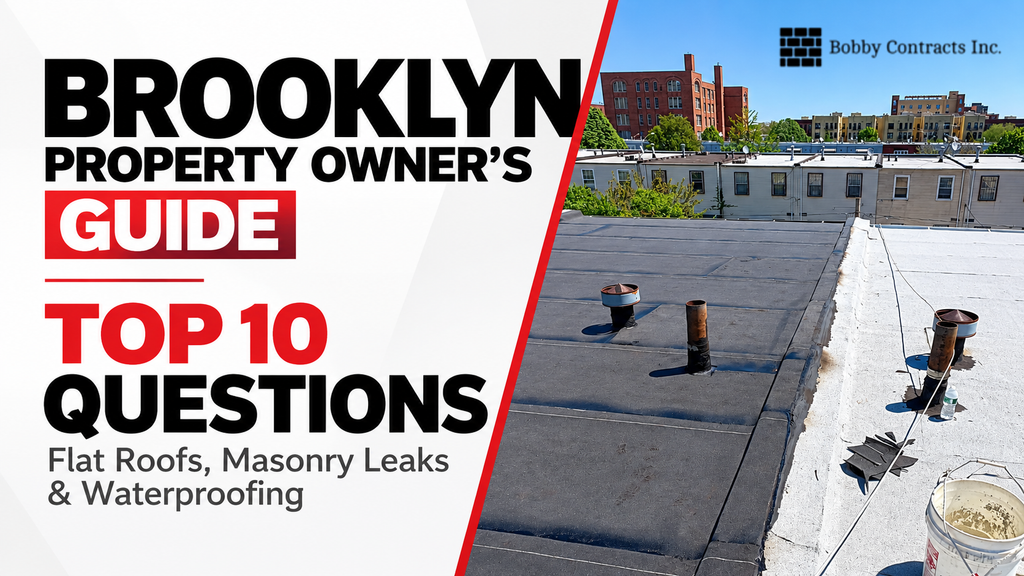
Brooklyn Property Owner’s Exterior Guide: Top 10 Questions on Flat Roofs, Masonry Leaks & Waterproofing
Maintaining an older property in Brooklyn—whether it is a classic brownstone in Park Slope, a multi-family rowhouse in Bushwick, or a commercial brick building in Bay Ridge—comes with unique architectural and weather challenges. From seasonal nor’easters and freeze-thaw cycles to century-old building materials, small exterior defects can quickly escalate into costly interior water damage.
To help property owners, landlords, and co-op boards navigate exterior upkeep, the masonry and roofing specialists at Bobby Contracts Inc. have compiled direct, expert answers to the 10 most critical exterior maintenance and leak questions we encounter across New York City.
Quick Navigation: Frequently Asked Questions
- Why is my brownstone facade or brick peeling and flaking?
- How long does a flat roof last in Brooklyn, and when should it be recoated?
- Why is water leaking into my top-floor ceiling when my roof membrane looks intact?
- How can I tell if a basement leak is groundwater, foundation failure, or plumbing?
- What is the difference between tuckpointing, repointing, and brick repair?
- What causes standing water (ponding) on a flat roof, and is it dangerous?
- What exterior maintenance is required for NYC Local Law 11 / FISP compliance?
- How do I stop rain from leaking through window lintels and sills?
- How much does an exterior leak inspection and estimate cost in Brooklyn?
- When is emergency leak repair necessary versus scheduled maintenance?
Meta Boxes
Use up and down arrow keys to resize the meta box pane.
Q1: Why is my brownstone facade or brick peeling and flaking?
The Short Answer:
Peeling, flaking, or crumbling brick and stone—technically termed spalling—occurs when liquid moisture penetrates porous exterior masonry and undergoes repeated freeze-thaw cycles. Because water expands by approximately 9% upon freezing, trapped moisture exerts intense internal pressure, popping off the brick face or outer brownstone veneer.
Detailed Explanation & Solutions:
Older Brooklyn buildings constructed before the mid-20th century primarily utilized historic, low-temperature fired brick and soft, sedimentary Connecticut brownstone. While exceptionally durable under natural breathing conditions, these materials are permeable.
Common triggers for accelerated facade spalling include:
- Inappropriate Coatings: Applying non-breathable standard acrylic or oil-based exterior paints. These trap migrating internal moisture behind a rubbery film, accelerating stone decay underneath.
- Deteriorated Mortar Joints: Missing or eroded mortar allows wind-driven rain to funnel directly behind the front wall.
- Freeze-Thaw Weathering: New York winters alternate rapidly between thawing rain and hard freezing temperatures.
How to Fix It:
Damaged sections must be gently raked or ground back to sound substrate. Individual shattered bricks must be cut out and replaced with salvage-matched or compatible low-density historic bricks. For brownstones, certified brownstone patching mortars applied in layered applications restore the decorative profile, finished with a breathable, vapor-permeable mineral silicate treatment.
Q2: How long does a flat roof last in Brooklyn, and when should it be recoated?
The Short Answer:
A professionally installed commercial or residential flat roof in New York City typically lasts between 20 and 30 years, depending on the membrane material (Modified Bitumen, EPDM, or TPO). Mineral-surfaced modified bitumen flat roofs should receive a fresh application of reflective aluminum silver roof coating every 3 to 5 years to protect the bitumen from UV degradation and thermal shock.
Signs It Is Time for Maintenance vs. Replacement:
- Needs Recoating (Maintenance): The silver finish has dulled to dark gray or exposed black asphalt; hairline alligator cracking is visible across the top bitumen coat, but seams remain tight and the insulation feels firm underfoot.
- Needs Structural Repair or Replacement: Large open seam splits; blistered pockets filled with water; spongy, soft roof decking underfoot (indicating wet, rotting roof insulation); or recurring ceiling leaks across multiple rooms during heavy storms.
Maintenance Tip: Regular re-silvering reflects harmful solar heat, reducing cooling expenses in summer and preventing the asphalt from turning brittle in winter.
For a detailed breakdown of roof systems, read our full guide on how long do flat roofs last on NYC brownstones or explore our professional commercial flat roofing services.
Q3: Why is water leaking into my top-floor ceiling when my roof membrane looks intact?
The Short Answer:
In historic Brooklyn rowhouses and brownstones, top-floor ceiling leaks frequently originate from vertical parapet walls, cracked terracotta coping stones, or failing chimney flashings, rather than the flat roof membrane. Water penetrates vertical brick mortar joints during driving rains, travels downward behind the roof flashing, and leaks directly onto top-floor ceilings.
Why Parapets Leak:
Parapet walls extend above the roofline and are exposed to weather on both sides. Over decades, building settlement and wind loads create hairline fissures in parapet mortar joints. Furthermore, the joints between coping stones (the stone caps resting atop the parapet) often crack, allowing gallons of rainwater to pour straight down into the brick core.
The Solution:
A thorough exterior leak investigation must always inspect both the horizontal roof membrane and the vertical masonry envelope. Proper repairs involve:
- Re-sealing or replacing coping stone joints with elastomeric masonry sealants.
- 100% repointing of cracked parapet brickwork.
- Installing waterproof membrane counter-flashing tucked cleanly into the masonry reglet joint.
If you are troubleshooting recurring water intrusion, learn more about why your roof leak may actually be coming from a chimney or flashing
or what to do when a roof leak keeps coming back after repair.
Q4: How can I tell if a basement leak is groundwater, foundation failure, or plumbing?
The Short Answer:
Basement moisture occurring primarily during or right after rainfall at the corner where the floor meets the wall indicates hydrostatic groundwater pressure. Water emerging steadily through concrete or rubble stone walls regardless of outdoor weather typically points to an underground plumbing or sewer issue. A white, chalky mineral film on your basement walls (efflorescence) signals continuous moisture migration through the foundation masonry.
Diagnostic Breakdown:
- Hydrostatic Pressure & Poor Grading: Water accumulates against older rubble stone or poured concrete foundations when exterior soil slopes toward the home or gutters discharge near the wall. Water seeks the path of least resistance through the cold joint where the floor slab meets the footing.
- Foundation Settlement Cracks: Diagonal or horizontal step cracks through brick or masonry block that actively seep mud or water during sustained rainfall require structural hydraulic cement sealing and exterior waterproofing.
- Internal Condensation: Tape a 1-foot square of aluminum foil tightly to your basement wall for 48 hours. If moisture forms on the room side of the foil, your basement has high humidity; if moisture forms behind the foil against the wall, moisture is seeping from the ground.
Understand the difference between cosmetic settling and structural danger by reviewing cracks in your foundation wall check why your Brooklyn basement is leaking after heavy rain or explore our dedicated basement waterproofing in Brooklyn NY solutions.
Q5: What is the difference between tuckpointing, repointing, and brick repair?
The Short Answer:
- Repointing is the structural process of cutting out decayed, crumbly mortar to a uniform depth (typically 1/2 to 3/4 inch) and repacking the joints with fresh, color-matched mortar.
- Tuckpointing is a traditional finishing technique where contrasting colored mortars are applied to create the visual illusion of crisp, razor-thin joints.
- Brick Repair involves removing cracked, spalled, or structural bricks entirely and relaying new bricks that match the building’s original compressive strength and color.
Why Historic Mortar Composition Matters:
Using modern Portland cement on a historic pre-1940s Brooklyn building can cause irreversible damage. Modern cement is rigid and impermeable. As the historic building settles, the softer brick bears the structural stress and shatters. Qualified masonry contractors always use soft, flexible, breathable lime-and-sand mortar formulations.
For more common masonry concerns, check our Brooklyn masonry contractor FAQ or see our specialized work for brownstone restoration in Park Slope
and historic facade restoration
Q6: What causes standing water (ponding) on a flat roof, and is it dangerous?
The Short Answer:
Ponding water is standing water that fails to drain or evaporate within 48 hours following precipitation. It is caused by inadequate roof pitch, clogged roof drains, sagged wooden roof joists, or compressed insulation. Ponding water accelerates chemical breakdown of the roofing membrane, promotes organic growth, and poses a structural risk due to immense deadweight load.
The Weight Factor:
Water weighs approximately 5.2 pounds per square foot per inch of depth. A large 10-foot by 10-foot ponding area sitting 2 inches deep adds more than 1,000 pounds of localized weight onto aging Brooklyn timber rafters, increasing the danger of roof sagging and sudden structural collapse.
The Correct Fix:
Avoid spreading thick coats of mastic or roofing tar over puddles, as this creates dams that trap more water. Long-term solutions involve installing a tapered polyiso insulation system to re-establish slope toward the scuppers or clearing and upgrading undersized interior roof drains.
To ensure your property meets NYC Department of Buildings standards, review our guide on what Local Law 11 is and if your building needs an inspection
and explore our Local Law 11 / FISP repairs program.
Q7: What exterior maintenance is required for NYC Local Law 11 / FISP compliance?
The Short Answer:
Under New York City’s Facade Inspection & Safety Program (FISP / Local Law 11), all buildings taller than six stories must have their exterior walls and appurtenances inspected every 5 years by a Qualified Exterior Wall Inspector (QEWI). Necessary repairs commonly include repointing deteriorated mortar joints, removing spalling masonry, securing loose architectural ornaments, replacing rusted window lintels, and rebuilding unstable parapets.
Classification Levels:
- SAFE: No exterior repairs required; facade is structurally sound.
- SWARMP (Safe With a Repair and Maintenance Program): Conditions that are currently stable but require repairs before the next cycle to prevent them from becoming dangerous.
- UNSAFE: Hazardous conditions (e.g., loose bricks, crumbling cornices) requiring immediate pedestrian sidewalk protection sheds and prompt repair work.
Note: Even if your residential building is under six stories and exempt from mandatory FISP filings, following FISP maintenance standards prevents costly DOB emergency violations and protects pedestrian safety.
Q8: How do I stop rain from leaking through window lintels and sills?
The Short Answer:
Window leaks usually do not stem from the window glass or sash; they occur when structural steel lintels above the window rust, expand, and fracture the surrounding brickwork (rust jacking), or when masonry sills below crack. Fixing this requires clearing out fractured mortar, treating the steel with rust-inhibitive coatings, installing flexible flashing with end dams, and applying professional-grade polyurethane sealants.
Why Surface Caulk Fails:
Homeowners often attempt to stop window leaks by applying silicone caulk along the window perimeter. If water enters the wall higher up from a compromised lintel or parapet, surface caulking traps water inside the masonry cavity, rotting window framing and causing hidden structural wood rot.
Q9: How much does an exterior leak inspection and estimate cost in Brooklyn?
The Short Answer:
Reputable local Brooklyn exterior contractors, including Bobby Contracts Inc., provide 100% free on-site visual inspections and itemized repair estimates for residential and commercial building owners.
What an On-Site Contractor Inspection Includes:
- Full walking inspection of the flat roof surface, seams, flashing boots, and drainage basins.
- Close visual check of roof parapets, coping stone joints, and chimney structures.
- Facade assessment checking for mortar erosion, cracked lintels, and brick spalling.
- Moisture evaluation for active water intrusion entry points.
Invasive testing, moisture-meter mapping, or engineer-certified FISP inspection reports may require specialized engineering consulting fees.
Q10: When is emergency leak repair necessary versus scheduled maintenance?
The Short Answer:
Emergency repair is required when active water intrusion flows near electrical panels or light fixtures, ceiling plaster is bowing downward under water weight, or exterior masonry bricks are loose above sidewalks or entryways. Routine repairs—such as hairline mortar repointing, preventative silver roof coatings, and minor stoop leveling—can be scheduled under standard working conditions.
Immediate Safety Actions During an Active Storm:
- Relieve Water Pressure: If a plaster or drywall ceiling is bulging with water, puncture the center with a screwdriver to drain water cleanly into a bucket, preventing a sudden, heavy ceiling collapse.
- Turn Off Electrical Circuits: Shut off breakers feeding wet rooms immediately.
- Contact an Emergency Exterior Contractor: Call for emergency tarping or temporary mastic sealing until weather clears for permanent, lasting repairs.
If you recently experienced severe weather, follow our checklist for checking for roof damage after a Brooklyn storm before attempting DIY repairs.
Protect Your Brooklyn Property with Proven Exterior Expertise
Exterior maintenance is the single most important investment you can make to safeguard the structural integrity, safety, and market value of your New York City building. Addressing minor joint cracks, ponding areas, and moisture seepage today prevents catastrophic interior remediation tomorrow.
Why Property Owners Trust Bobby Contracts Inc.
- 20+ Years of NYC Experience: Proudly serving Brooklyn and all NYC boroughs since 1998.
- Comprehensive Exterior Services: Licensed and insured in Roofing, Brick Pointing, Historic Brownstone Restoration, Waterproofing, Lintel Replacement, and Parapet Wall Repair.
- Dedicated Craftsmanship: From emergency leak response to complete historic facade restorations, we deliver reliable, long-term construction solutions.
Ready for an honest, professional assessment of your building?
- Location: 171 Bay 17th St, Brooklyn, NY 11214
- Phone: (917) 704-7174
- Website: bobbycontracts.net
Contact Bobby Contracts Inc. today to schedule your complimentary on-site inspection and free estimate.